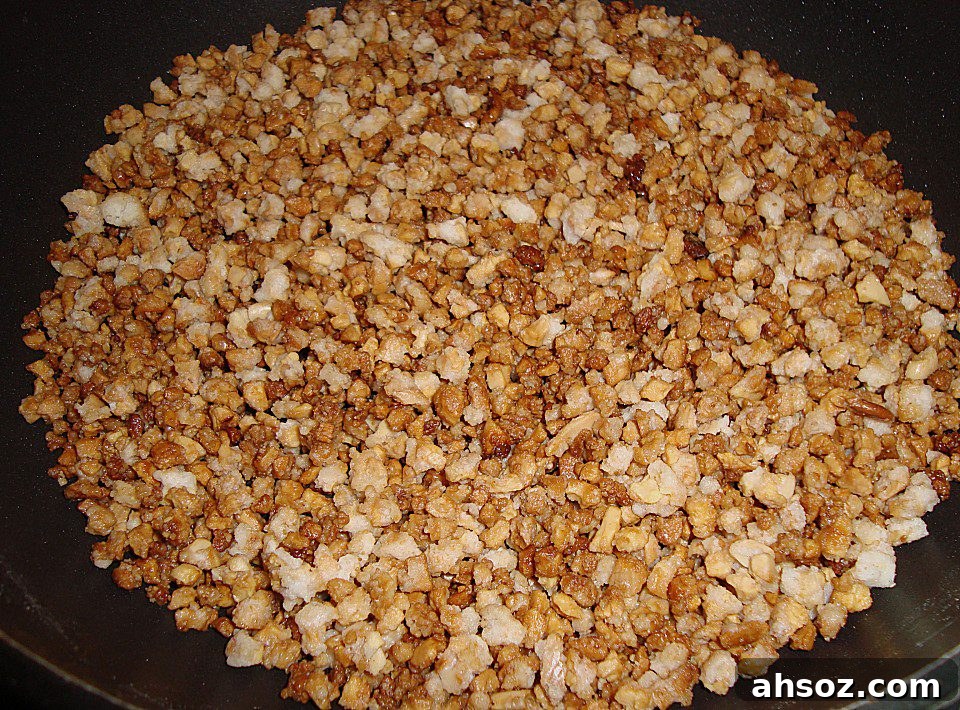
Homemade Krokant is an essential ingredient for classic German desserts, especially the famous Frankfurter Kranz Cake. In Germany, Krokant is easy to find in most baking aisles, but in the United States it is not commonly sold in regular supermarkets. The closest English description would be finely chopped nut brittle, caramelized nut crunch, or sweet crunchy nut crumbles. Unlike large pieces of brittle, Krokant is usually broken into small, even pieces so it can be used as a coating, topping, or decoration for cakes, pastries, ice cream, puddings, and other desserts.
Making Krokant from scratch is simple, quick, and requires only a few basic ingredients. All you need are chopped almonds or hazelnuts, sugar, and a little butter. The sugar melts into a golden caramel, coats the nuts, and turns into a crisp, fragrant crunch once cooled. Homemade Krokant tastes fresher than store-bought versions and allows you to control the color, texture, and size of the crumbs. It is especially useful when preparing traditional German recipes, but it is also delicious sprinkled over whipped cream, yogurt, custard, fruit desserts, or vanilla ice cream.
Ingredients How to Make Krokant
100 g chopped almonds or hazelnuts
120 g sugar
2 tbsp butter
parchment paper or wax paper to cool and dry the Krokant
Cooking Instructions
- Prepare a sheet of parchment paper or wax paper before you start cooking. Once the caramelized nuts are ready, you will need to spread them out immediately, so it is best to have the paper waiting on the counter.
- Place the butter and sugar in a wide pan or a heavy-bottomed pot. Heat the mixture over medium heat and allow the butter to melt into the sugar. Stir gently as the sugar begins to dissolve and turn glossy.
- Add the chopped almonds or hazelnuts to the pan. Stir constantly with a wooden spoon for about 5 to 6 minutes. Avoid using a metal spoon if possible. The nuts should become evenly coated in the melted sugar and should take on a light golden-brown color.
- Keep the mixture moving while it cooks so the sugar does not burn in one spot. Caramel can change color quickly, so watch the pan carefully. The Krokant is ready when the nuts smell lightly toasted and the caramel has reached a warm golden shade.
- Pour the hot nut mixture onto the prepared parchment paper. Spread it out as thinly as possible with the wooden spoon. Be careful, because the caramel will be very hot.
- Let the Krokant cool completely at room temperature. Do not cover it while it is still warm, because trapped steam can make it sticky instead of crisp.
- Once cooled and hardened, break the Krokant into smaller pieces. You can use a rolling pin to crush it gently, or place the pieces in a sturdy plastic bag and roll or tap them until they reach the desired size.
Store the finished Krokant in a clean jar with a tight-fitting lid. Keep it in a dry place so it stays crisp. If your kitchen is humid, it is best to use the Krokant soon after making it, because caramelized sugar can absorb moisture from the air. Freshly made Krokant is perfect for decorating the outside of a Frankfurter Kranz Cake, but it can also be used as a crunchy topping for cream cakes, cupcakes, German tortes, ice cream sundaes, or simple homemade desserts.
How to Peel Almonds
For the best-looking Krokant, peeled almonds are often preferred because they create a lighter, cleaner appearance. If you cannot find peeled almonds at the store, you can peel them easily at home. It takes a little extra time, but the process is simple and worthwhile, especially when you are preparing a traditional German cake such as Frankfurter Kranz Cake.
Instructions
Place the almonds in boiling water for 2 minutes.
Drain the almonds and rinse them immediately with cold water.
Take one almond at a time and press it gently between two fingers. The skin should loosen, and the almond will slip out easily.
Place the peeled almonds on a clean kitchen towel and let them dry well before chopping or using them for Krokant.
Whether you use almonds or hazelnuts, homemade Krokant adds a beautiful caramel flavor and a crisp texture to many German desserts. It is one of those simple baking basics that is very useful to know, especially if you enjoy making traditional cakes from scratch. Once you have prepared it a few times, you can adjust the texture to your preference, from slightly coarse pieces for cake decoration to finer crumbs for sprinkling over creams and puddings.